


Sputter targets are indispensable raw materials for producing functional thin films in semiconductors, display panels, photovoltaics, and other fields. Their role in various deposition processes makes them technologically irreplaceable. By selecting different target materials, manufacturers can obtain films with different functions such as conductivity, diffusion barrier properties, or optical characteristics. Among all application fields, semiconductors impose the strictest technical requirements on sputtering targets, resulting in the highest material purity standards and prices. One key material in this context is the Sputter Target.
What's the definition of sputtering targets?
Sputtering targets are used in both the wafer fabrication and chip packaging stages.
In wafer fabrication, they serve mainly as the metal source for sputter deposition.
In chip packaging, they are commonly used in metallization for bonding and interconnect layers.
For integrated circuits, metal sputtering targets play a critical role in forming the conductive pathways responsible for transmitting electrical signals across the chip.
What's the technical requirements of sputter targets?
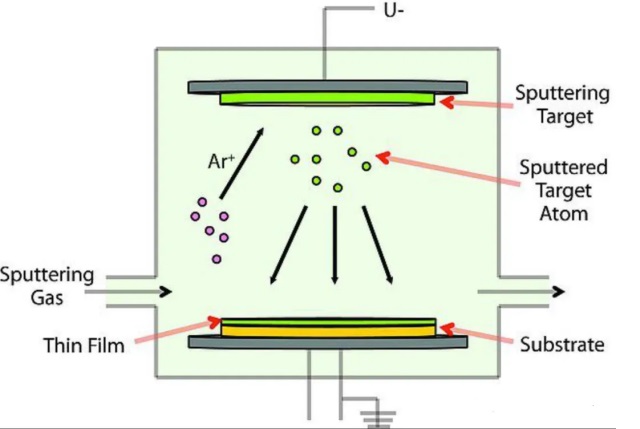
The sputtering process relies on ion bombardment to eject atoms from a solid target, which then deposit onto a wafer or substrate to form thin films with electrical, mechanical, or protective functions. Since these films are essential components of integrated circuits, semiconductor-grade sputtering targets are subject to stringent requirements in purity, density, grain size and orientation, as well as surface quality.
(1) Purity
The purity of a metal sputtering target directly determines the purity and performance of the deposited film. Even trace impurities may degrade electrical, optical, or mechanical properties. Target purities are classified as 3N, 4N, 5N, 6N, and 7N, where “N” represents the number of nines in the purity percentage. Semiconductor applications typically require 5N (99.999%) to 6N (99.9999%) purity.
Additionally, the content of alkali metals (K, Na, Li), radioactive elements (U, Th), transition metals (Fe, Ni, Cr), halogens (Cl), and gaseous impurities (C, O, N) must be strictly controlled to prevent contamination of gate dielectrics and ensure device stability.
(2) Grain Size and Orientation
Grain size influences sputtering rate because atoms near grain boundaries are more easily ejected. Finer and more uniform grains result in more stable deposition rates and more uniform film thickness. Semiconductor targets typically require grain sizes below 100 μm.
Grain orientation also affects sputtering behavior, as atoms preferentially sputter along close-packed directions. Engineering the crystal orientation can thus improve deposition efficiency and consistency.
(3) Density
The density of a sputtering target should be close to its theoretical density, with minimal porosity. Low-density targets contain voids that may trap impurities and cause abnormal discharge during sputtering, ultimately affecting film quality and deposition stability.
(4) Surface Quality
Surface protrusions or irregularities can cause localized electric field enhancement, leading to arcing or discharge during sputtering. Therefore, targets must exhibit excellent flatness, straightness, and surface roughness.

What's the application areas of sputtering targets?
High-purity sputtering targets are primarily used in four major sectors: display panels, information storage, solar cells, and semiconductor chips.
(1) Chip Targets
Chip-grade targets are among the most technologically demanding materials. Semiconductor processes require ultra-high-purity metals and precisely engineered dimensions. Common materials include high-purity copper, aluminum, titanium, tantalum, and copper-manganese alloys. For advanced integrated circuits, aluminum targets typically require purities above 5N5.
(2) Display Panel Targets
Display applications use high-purity aluminum, copper, molybdenum, and indium tin oxide (ITO). These targets must support large-area, uniform deposition for products such as high-definition televisions and laptops. Aluminum targets for display panels generally require 5N purity or higher.
(3) Information Storage Targets
Information storage devices require materials that support high recording density and fast data transmission. Examples include Co, Ni, Fe and their alloys for magnetic recording layers; Ru for non-magnetic spacer layers; and Ta, Cu for conductive or buffer layers. These targets demand exceptional magnetic stability, film uniformity, low defect levels, and compatibility with multi-layer nanostructures.
(4) Solar Cell Targets
Solar cell technologies use a variety of sputtering targets depending on the device type. CIGS cells require copper, indium, gallium, selenium, and molybdenum targets; CdTe cells use cadmium and tellurium; and transparent conductive layers across multiple photovoltaic technologies commonly use ITO or AZO. These targets must support high purity, uniformity, and large-area coating to improve conversion efficiency and reduce manufacturing costs.
Conclusion
As the semiconductor industry continues to advance toward higher performance, greater integration, and larger-scale manufacturing, the importance of sputtering targets is becoming increasingly prominent. They not only directly affect the quality of functional thin films but also determine device reliability, energy efficiency, and overall process yield.
Looking ahead, sputtering targets will continue to see technological breakthroughs in purity control, compositional design, sintering processes, and large-size fabrication, strengthening their role as one of the core foundational materials supporting the ongoing evolution of the global electronics industry.