


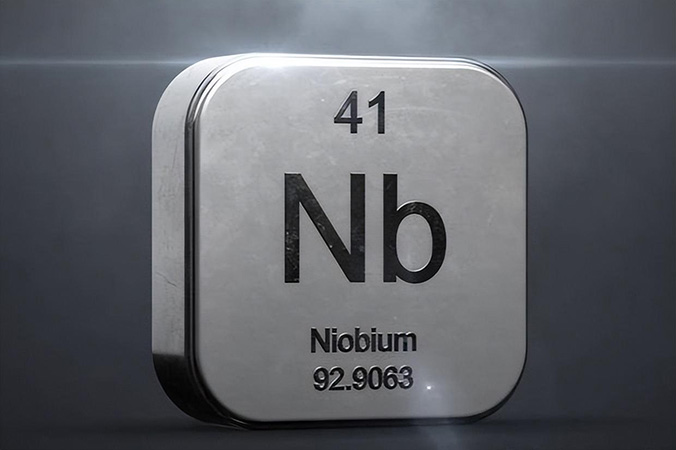
Niobium is a silver-gray, lustrous transition metal known for its exceptional strength, ductility, superconductivity, and corrosion resistance. It is widely used in aerospace, superconducting materials, and many other high-technology fields.
What is niobium used for?
1. Steel Industry
Microalloying: Approximately 85%–90% of the world’s niobium is used in the form of ferroniobium for steel production. Adding a small amount of niobium (0.03%–0.05%) to steel can increase its yield strength by more than 30%. Nb enables fine, dispersed precipitates through precipitation strengthening and controlled cooling, allowing steel toughness to be adjusted over a wide range.
This not only increases steel strength but also improves toughness, resistance to high-temperature oxidation and corrosion, lowers the ductile–brittle transition temperature, and enhances weldability and formability.
Improving Microstructure: Nb refines steel grains and promotes uniform microstructure. In ultra-low-carbon bainitic steels, trace niobium suppresses recrystallization during deformation, increases strain accumulation in austenite, and raises dislocation density before phase transformation. Niobium carbides and nitrides hinder dislocation movement and provide significant precipitation strengthening, greatly improving overall steel performance.
2. Aerospace Industry
Engine Components: The aerospace sector is the primary user of high-purity niobium. Niobium-tantalum heat-resistant alloys have excellent thermal strength, heat resistance, and workability and are used in rocket and spacecraft engines—such as combustion chambers, turbine blades, and nozzles—to ensure stable, efficient performance under extreme temperature, pressure, and rotational conditions.
Aircraft Structural Parts: Nb alloys combine low density with high strength, making them ideal for key structural components such as landing gear and wing beams. Their use reduces aircraft weight, improves fuel efficiency and flight performance, and ensures structural reliability in demanding flight environments.
3. Superconducting Materials Industry
Superconducting Magnets: Certain niobium compounds and alloys (e.g., Nb-Ti, Nb-Sn) have high superconducting transition temperatures and are widely used in industrial superconductors. In equipment such as superconducting generators, accelerator magnets, and superconducting magnetic energy storage systems, Nb-based superconductors carry large currents with almost zero resistance, generating extremely strong magnetic fields and enhancing device efficiency and performance.
Medical Equipment: Magnetic Resonance Imaging (MRI) machines rely on niobium superconducting magnets to produce stable, high-intensity magnetic fields for clear, accurate imaging of internal human structures. Nb-based superconductors are also used in nuclear magnetic resonance (NMR) instruments for analytical applications, improving spectral precision.
4. Nuclear Industry
Nuclear Fuel Cladding: Nb has high thermal conductivity, a high melting point, excellent corrosion resistance, and a low neutron absorption cross-section. These properties make it an ideal material for nuclear fuel cladding, ensuring containment of radioactive materials and maintaining structural stability under high temperatures and intense radiation inside reactors.
Reactor Structural Materials: Nb is used in heat-exchanger structures within nuclear reactors. Its thermal conductivity and corrosion resistance ensure efficient heat transfer and medium separation, supporting safe and stable reactor operation.
5. Electronics Industry
Capacitors: Nb-based ceramic materials are used in capacitor production. Single crystals such as lithium niobate (LiNbO₃) and potassium niobate (KNbO₃) possess excellent piezoelectric, thermoelectric, and optical properties. They are widely used in optoelectronics and electronics—for example, in filters, sensors, and optical modulators.
Vacuum Electronic Devices: Niobium’s high melting point, strong electron emission capability, and gettering properties make it suitable for electronic tubes and other vacuum devices. In vacuum tubes, Nb helps remove residual gases, enhancing performance and stability.
6. Medical Field
Medical Devices: Nb has outstanding physiological corrosion resistance and biocompatibility. It does not react with bodily fluids and causes minimal tissue damage. It also tolerates all sterilization methods.
Thus, Nb is widely used in medical implants and instruments such as bone plates, cranial plates, bone screws, dental implants, and surgical tools—ensuring safety and reliability after implantation and promoting tissue healing.
Components in Medical Equipment: Some advanced medical equipment, such as radiotherapy systems, use niobium components. Its unique physical and chemical properties ensure stable operation under complex working conditions and improve clinical performance.
7. Other Applications
Chemical Industry
Nb is highly resistant to acids and liquid-metal corrosion, making it suitable for cookers, heaters, coolers, and other chemical-processing equipment. It maintains structural integrity and performance in corrosive environments. Niobates also serve as important catalysts, accelerating chemical reactions and improving industrial efficiency.
Casting Industry
Nb forms hard carbides that enhance material wear resistance. It can also modify the shape and size of graphite flakes. It is commonly used in automotive components such as cylinder heads, piston rings, and brake pads to improve durability and service life.
Optics and Lighting
Nb enhances lens transparency and is used in optical lens manufacturing. In the lighting industry, niobium-zirconium alloys (containing about 1% Zr) serve as precision supports in high-efficiency sodium vapor street lamps, offering high thermal strength, good formability, and excellent sodium-vapor corrosion resistance for stable long-term illumination.
Common niobates and their uses
| Product | Application |
|---|---|
| Niobium Pentoxide (Nb₂O₅) | Used to produce electronic capacitors, optical glass, or as a raw material for synthesizing other niobium compounds. |
| Lithium Niobate (LiNbO₃) | Widely applied in optical devices, optical modulators, and surface acoustic wave devices. |
| Niobium Pentachloride (NbCl₅) | Used as a Lewis acid catalyst in organic synthesis, such as Diels–Alder reactions; also used as a precursor for preparing organometallic niobium compounds. |
| Niobium Nitride (NbN) | Used in the production of infrared detectors. |
| Niobium Carbide (NbC) | Used as ceramic coating material. |
| Niobium Germanide (NbGe2), Niobium–Tin (Nb₃Sn) | Used to make superconducting wires. |
Thanks to its unique properties, Nb plays an increasingly vital role in high-technology industries. It has become an essential driver of scientific and technological progress and contributes significantly to the advancement of modern industry and human society.